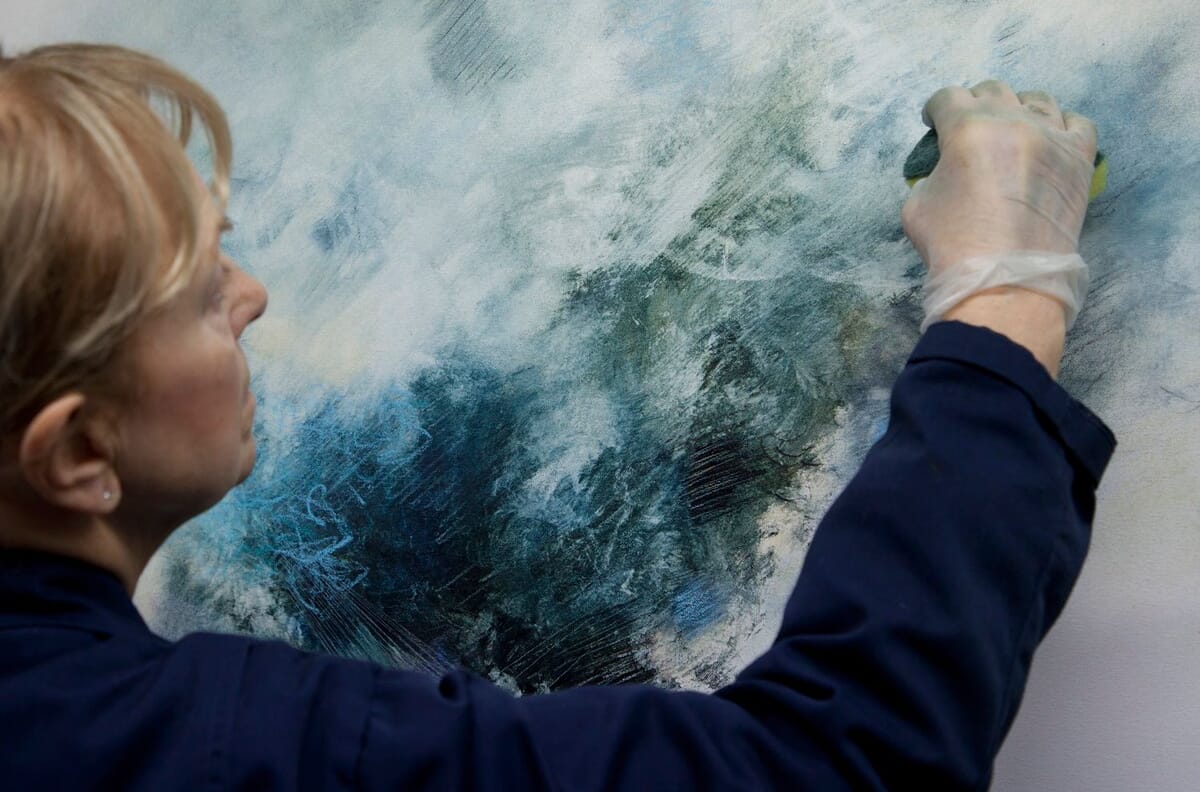
Anselm Kiefer once remarked, “Art is longing. You never arrive, but you keep going in the hope that you will.” For Gina Parr, this sentiment embodies both a challenge and a calling. Her work seeks to capture the unspoken, delving into the interplay between perception and emotion. Rather than depicting specific places or times, her paintings serve as instinctive reflections of inner landscapes. They are rich in texture and emotional resonance, encapsulating memories, grief, and the weight of yearning without the need for justification.
Parr’s artistic path has been shaped by her life experiences as much as by her craft. Having spent 25 years as a set designer for BBC television, she created immersive environments for others. Now, she paints a space that is distinctly her own, one that is rooted in reality yet often eludes the truth. “It’s a quest, in effect, to design the space that I was denied as a child,” she explains.

Parr openly discusses how her early life continues to influence her art. The loss of her father at 17 and her mother’s struggles with hoarding are pivotal experiences. She reminisces about the tranquility of fishing with her father, which was often intertwined with an underlying tension—brief moments of peace amidst familial chaos. This duality is reflected in her work, striking a balance between serenity and turmoil.

Upon viewing her work, one may sense a simultaneous expansion and contraction, akin to the rhythm of the ocean. There is an impression that events have transpired, are occurring, and will continue to unfold—evoking the cyclical nature of trauma. Notably, in 2004, Parr survived the Boxing Day Tsunami with her family.
Her art traverses the terrain of memory, always present yet elusive. This experience of division—life segmented into before and after—has significantly influenced her perception of both physical and emotional spaces. Her paintings suggest that absence is not merely a void; it possesses its own presence, resonating with what was or what could have been.

In this way, her work serves as a cathartic exploration of emotional landscapes—a journey through internal realms to comprehend and resolve the complexities of pain and heartache. Parr often articulates the tension between excess and restraint, describing her paintings as oscillating between “clutter and clear.” It is within this dynamic that she discovers meaning, pushing beyond comfort to unearth something raw and authentic.

While Parr draws heavily from nature, her mark-making often stems from introspection rather than external observation. “There’s a need and a comfort in repeating images, to make patterns.” This may reflect a human tendency to revisit past wounds and desires as a means of understanding or clinging to unresolved feelings. “I’ll never find a solution to that childhood trauma, but I’m driven every day to creatively pursue it.”
Photography naturally complements Parr’s painting. When traveling or away from her canvas, the camera serves as her brush. “I’m always looking at walls, sides of boats, and other intriguing surfaces… just stuff in the urban sprawl. I’m searching for paintings on those surfaces. The connection is that I’m looking for a chimerical space that already exists—whether created by weather, humans, graffiti, or some serendipitous weathering.”

These photographs transcend mere studies; they are akin to her paintings, emerging from the same desire to extract meaning from surface and memory from matter. Each frame captures an element of chance, revealing something quietly sacred. The artist embraces this unpredictability—both in capturing what the universe places in her path and in those spontaneous moments during painting when unexpected elements arise.
“I often think about Picasso and that quote about spending our entire lives trying to paint like the children we once were—uninhibited.” Although her work draws upon past experiences, Parr yearns to “return to the freshness, the wonderful gut reaction to creating something.” This instinctive response adds a sense of lightness to her practice—it’s not solely about darkness and discomfort. “I actually have a joyous relationship with the canvas. Everything I’m thinking, feeling—all my movements—go into that canvas. I’m so immersed in the process. There are flashes, as I work through it, where I feel that it’s going to be okay.”

Each piece is a journey—a struggle between the perfectionist’s urge to tidy and the artist’s need to leave marks raw and exposed. The outcome is artwork that feels vibrant: layered, searching, and caught between resolution and unrest. “Painting is a battle between controlled intention and spontaneity,” she reflects. “I guess I’m looking towards the end of each painting, for it to feel right—pictorially and emotionally.”
The Portuguese term saudade—an indescribable longing for something lost—resonates when Parr discusses the essence of her practice. Her paintings encompass more than just grief or trauma; they are shaped by these experiences, imbued with longing and illuminated by moments of relief. “It’s a balance between longing and love,” she expresses. Her work embodies movement: inching forward, circling back, and always daring to be brave.
 | Rise Art Source: https://www.riseart.com/article/2777/gina-parr-always-daring-to-be-brave Fine art meets contemporary interiors. We're pleased to collaborate with Soho Home to provide original artwork from emerging and celebrated artists. |