A linesheet (or line sheet) is the document you send wholesale buyers so they can place an order: each style with its number, colours, sizes, wholesale price, suggested retail price, minimums and delivery dates, as Wikipedia’s entry summarizes it (checked September 2026). And yes, you still need one.
Syndicate builds wholesale fashion suppliers and distributors their own online stores, so we have a stake in how your buyers order. We think your linesheets should stay, and here’s why.
Why do linesheets take up so much of your week?
Because the linesheet does two jobs. It presents the collection, and it’s also the order form. The second job is where the hours go.
- Your graphic designer spends hours preparing PDFs and editing pictures every season.
- Every account has its own prices, so you keep several copies of the same PDF, and the right one has to reach the right buyer.
- The catalogue changes mid-season, and orders keep coming in off last month’s version.
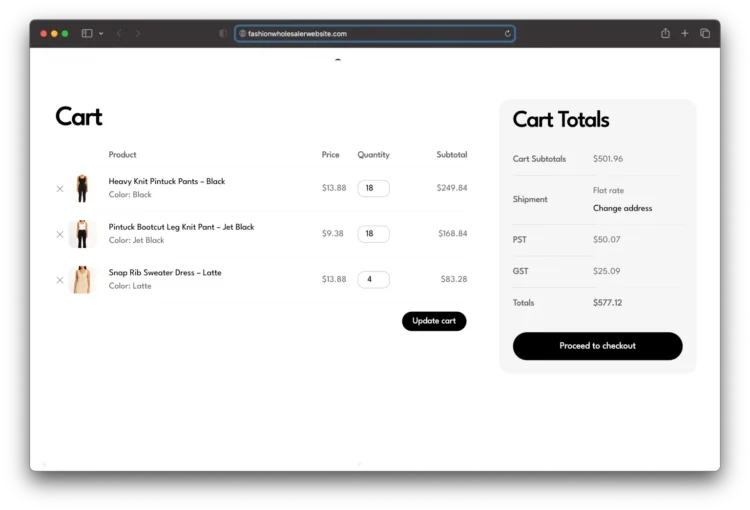
- Orders come back as marked-up PDFs, emails and spreadsheets, and each one is retyped before anything ships.
If that’s your week, the linesheet isn’t the problem. Using it as the order form is.
What goes on a line sheet?
There’s no fixed template, but the fields are consistent across the industry. Techpacker’s guide lists product names, descriptions, materials, sizes and colours for every style. It adds ordering information and sales terms, with both suggested retail and wholesale prices. Wikipedia adds style or SKU numbers, swatches or Pantone references, minimum order amounts, order cutoff dates, and contact and delivery information.
| Field | What your buyer uses it for |
|---|---|
| Photo or flat sketch | Recognising the style at a glance |
| Style number or SKU | Writing the order without ambiguity |
| Colours, swatches or Pantone references | Choosing colourways |
| Size range | Building the size run |
| Wholesale price and suggested retail price | Working out their margin |
| Minimum order amounts | Knowing what they have to commit to |
| Delivery window and order cutoff date | Planning the season’s floor |
| Terms, contact and delivery information | Placing the order and getting paid on time |
How is a linesheet different from a lookbook?
A lookbook sells the mood; a linesheet sells the specifics. Techpacker describes the lookbook as highly stylized photography meant to create an emotional connection, and the linesheet as the hard facts a buyer needs to decide on an order. JOOR makes the same distinction: the lookbook introduces your brand’s aesthetic, and the linesheet carries the size ranges and prices. Most brands need both, and buyers read them for different reasons.
Do you still need a linesheet if you sell online?
Yes. Selling online changes what the linesheet has to do, not whether you have one.
- It’s still how you’re introduced. JOOR notes that linesheets are handed out at trade shows and market appointments, or sent digitally when selling remotely. A buyer who has never heard of you won’t start by logging in to your store.
- It may be your only presentation. Wholesale In a Box points out that most store owners who get your linesheet have never seen your products in person, so it has to carry the whole pitch.
- Your long-standing buyers know it. Some accounts will keep ordering the way they always have, and forcing a change on them costs goodwill you don’t need to spend.
What changes is the second job. When buyers can order online, the linesheet goes back to presenting the collection, and the order arrives already structured instead of as a marked-up PDF. Even the wholesale platforms build around it: JOOR’s plans list “Linesheet Software & Style Catalog” as a core feature, checked September 27, 2026.
How do you keep your linesheets and take orders online?
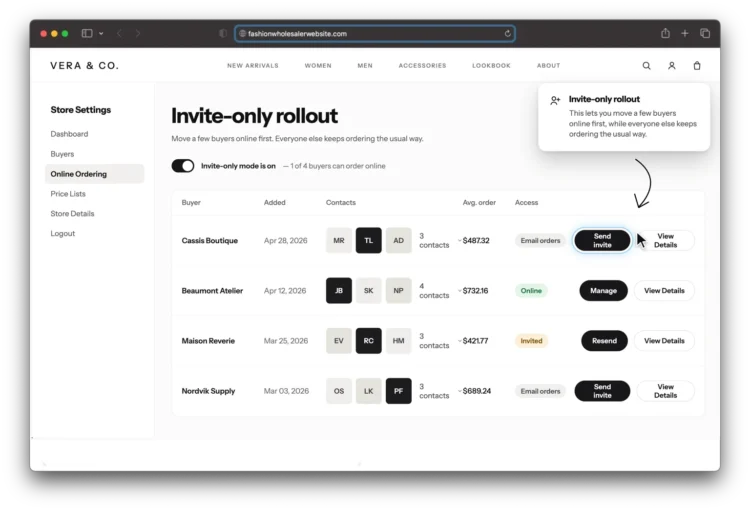
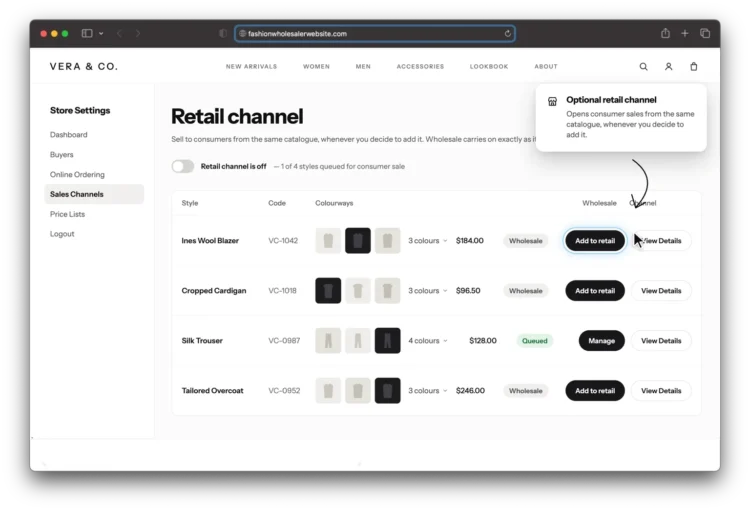
You run both. The online store sits alongside your email and PDF linesheet ordering. You invite buyers a few at a time, starting with the ones most likely to use it, and everyone else keeps ordering the way they do today. Nobody is switched over on day one. That’s how we set up wholesale stores for fashion brands.
If you’re planning a store on Shopify, the number of different price lists you send out today decides which plan you need. Our guide to Shopify B2B without Plus explains how to count them.
When is a PDF linesheet all you need?
Sometimes the PDF and an email inbox are the right system, and you should keep your money.
- You sell to one or two large accounts and speak to the buyer anyway. The order is a formality at the end of a conversation.
- You want your collection kept private. If you don’t want your range visible online at all, don’t put it there.
- Someone else runs your wholesale. If an agent or your retail partners handle ordering, their process is the one that matters.
What does the research say about how linesheets are used now?
The clearest account we found is from Wholesale In a Box, published April 2026. It describes how the linesheet began as a bare-bones reminder that store owners took away from a trade-show booth. As trade shows got more expensive and less reliable for smaller brands, and as marketplaces and direct outreach grew, many brands moved to a hybrid of linesheet and lookbook that also has to tell the brand’s story. It’s a practitioner’s account rather than a survey, and we didn’t find a survey of how brands use linesheets today. Read it as one experienced view of the shift, not as a measurement.
Sources here were checked in September 2026. Platform features and industry guidance change, so confirm the details at the linked pages before you rebuild your process around them.
If you’d like to see an online store running next to a PDF linesheet, we’re happy to show you one. Book fifteen minutes or call 1-844-404-4796.