Set wholesale order minimums at two levels: units per style, often 6 to 24 in clothing according to RepSpark’s August 2026 guide, and a dollar minimum per order. Then make reorders easier than first orders. Faire suggests $100 to $150 for first orders on its marketplace.
Syndicate builds wholesale fashion suppliers and distributors their own online stores, so we have a stake in what you choose. The figures below come from the sources linked next to them.
Why do small wholesale orders cost more than they look?
Because the work doesn’t shrink with the order. Four pieces still need an email thread, an invoice, picking, packing and shipping. RepSpark, which makes ordering software for clothing brands, estimates a single small order can eat up $50 to $150 in admin once staff time and shipping are counted.
- A buyer emails for three tops in one colour, and you break open a case to fill it.
- The minimum gets negotiated account by account, because nobody wants to turn down an order.
- The buyer only finds out about the minimum after building the order, and the order disappears.
A minimum isn’t there to keep buyers out. It marks the point below which you’re paying to ship.
What’s the difference between a style minimum and an order minimum?
They do different jobs, and most fashion brands need both. RepSpark describes three kinds:
- A style minimum: the fewest units of one style a buyer can order, like 6 of a jacket.
- An order minimum: a floor for the whole order, like $500, so ten styles at their minimums can’t add up to an order that loses you money.
- A category minimum: different floors for outerwear, bottoms or accessories, because the price points differ.
That last one matters more than it looks. The same unit minimum asks very different things of a buyer depending on your price:
| Style | Wholesale price | Buyer spends at 6 units | At 12 units |
|---|---|---|---|
| T-shirt | $25 | $150 | $300 |
| Dress | $60 | $360 | $720 |
| Coat | $400 | $2,400 | $4,800 |
So don’t put the same minimum on a $30 tee and a $400 coat. Outerwear usually gets a lower unit minimum, because each piece brings in more.
How do you work out your wholesale order minimums?
Start from your own costs, not from what a competitor charges. RepSpark’s approach, step by step:
- Start with your factory’s minimum. Your factory and fabric minimums decide how big a run your wholesale orders need to support. Custom-dyed colours and branded trims can push that up a lot, so get the numbers in writing first.
- Find your break-even. Divide your fixed costs by the gap between your wholesale price and your cost per unit. In RepSpark’s example, $8,000 in fixed costs, a $45 wholesale price and an $18 unit cost means about 297 units.
- Make sure each order covers its handling. RepSpark suggests keeping processing costs under 15 to 20% of the margin an order brings in.
- Test it on your smallest target account. If the boutique you most want can’t place a meaningful order at your minimum, the minimum is wrong for them.
Should first orders and reorders have different minimums?
Yes. A new account hasn’t shown it can sell your line yet, and an account reordering a style has. RepSpark suggests higher minimums for new accounts, lower ones for regulars, and low or no minimums on reorders of styles that are already selling. It adds that many brands set lower minimums on pre-season orders, which help you plan production, than on orders shipped from stock.
Faire’s guide for brands (August 2026) does the same split, with separate minimums for first-time and repeat buyers, and suggests $100 to $150 for first orders. Faire writes that for every kind of brand on its marketplace, so treat it as the low end for fashion, where one dress can cost $60 wholesale.
How should sizes and colours count toward the minimum?
Decide before your first buyer asks, because they will. RepSpark describes three ways to do it:
- Free split: six units of a style in any mix of colours and sizes. It’s easiest for the buyer, hardest for your planning, and common with newer brands.
- Per-colour minimums: a minimum for each colour, often 3 units. It’s cleaner for production, and standard once you’re bigger.
- Size packs: a fixed run, like 1 XS, 2 S, 2 M and 1 L. It locks in your size curve and suits basics best. Buyers of fashion pieces usually want to choose their own sizes.
Where should buyers see your minimums?
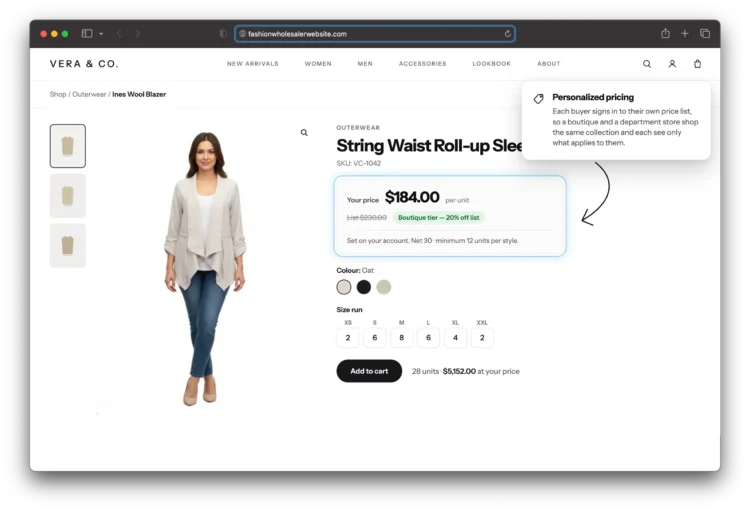
Wherever they decide what to order, and before they build the order. RepSpark’s warning is blunt: a buyer who adds four units, gets to checkout and finds a six-unit minimum often won’t go back and add two. They just leave.
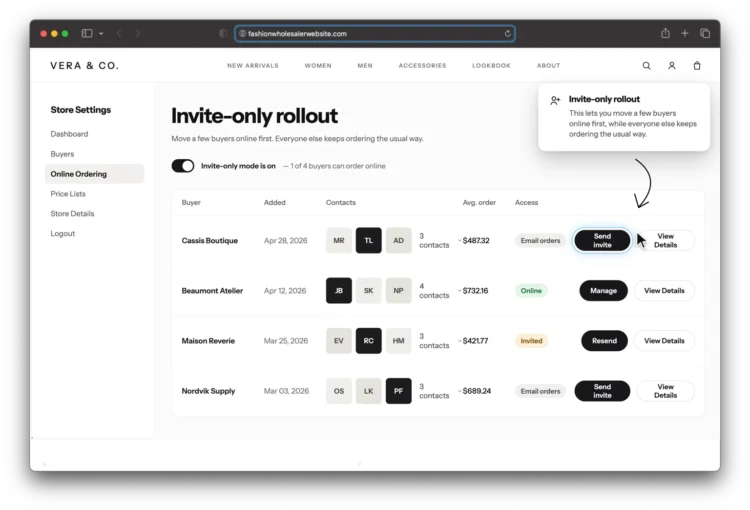
So put minimums on your linesheet next to each style (our guide to linesheets covers what else goes there). If buyers order online, have the store check them at checkout. On a wholesale B2B store, that means nobody on your team has to say no by email. We’ve covered how to take wholesale orders online separately.
When should you waive or lower a minimum?
Rarely, and on purpose. RepSpark gives three ways to handle an order under your minimum: turn it down, add a small-order fee to cover the extra handling, or make a one-time exception for an account that matters. Faire goes further for low-priced products, saying you can drop the minimum entirely if you’re fine with small orders. What RepSpark warns against is lowering your minimum to get through a slow season. Once buyers have seen the lower number, they’ll expect it to stay.
What does the research say about typical clothing minimums?
RepSpark’s August 2026 guide puts typical clothing minimums at 6 to 24 units per style. Newer brands often set 6 to 12, and established brands with bigger runs 24 to 50. It also notes that boutiques want around 4 to 8 units while chains buy 24 to 48, which is why one number rarely fits both. RepSpark sells ordering software to clothing brands, and these figures come from its work with them rather than an independent survey. Your own numbers are the best guide: after each season, compare your average order with your minimum, and count how many exceptions you were asked for.
We checked these sources in September 2026. Norms and platform features change, so double-check before you send new terms to your buyers.
Would it be a bad idea to talk through minimums for your range, and how they’d work with buyers ordering online? Book fifteen minutes or call 1-844-404-4796.