The productivity mega deduction would let Canadian apparel businesses deduct the full cost of most new equipment, furniture and computers in the year they start using them. Finance Canada proposed it on September 15, 2026, and Budget 2026 carried it forward on November 5, though it isn’t law yet.
Syndicate builds wholesale fashion suppliers and distributors their own online stores, so we have a stake in what you choose. We’ve set out the tax rules the way Finance Canada and the CRA publish them, and we aren’t your accountant.
Where do the hours in your wholesale week go?
Still building linesheets and lookbooks? Still making product PDFs with different pricing for each customer, emailing them out, and waiting for buyers to answer? Those are the jobs apparel brands and distributors tell us eat their week.
Maybe you’ve moved part of it into a tool like Brandboom or ApparelMagic, or maybe orders still arrive by phone and text. However it works today, hold on to that list, because it’s the best guide to what this tax break should go toward.
What is the productivity mega deduction?
The productivity mega deduction is a federal proposal that would let Canadian businesses deduct the full cost of most new depreciable property in its first year. It would apply to anything acquired on or after September 15, 2026, according to Finance Canada’s backgrounder. Normally you write off a purchase a slice at a time through capital cost allowance (CCA), the Canada Revenue Agency’s (CRA) version of depreciation. Taking it all in year one means your tax bill drops sooner.
That same September 15 backgrounder says the measure would be permanent and would reach about two-thirds of capital investment. That’s up from about 15% under last year’s Productivity Super-Deduction, at a cost Finance estimates at $36 billion over five years. It leaves out buildings in Classes 1 and 3, goodwill, franchises and licences, and certain vehicles. Used equipment counts only when neither you nor anyone related to you owned it before. Sole proprietors and partnerships with individual members can’t use the deduction to create a loss.
Budget 2026 describes the write-off as permanent and leaves eligibility to the CRA case by case. The bill itself hasn’t been tabled yet. Finance Minister François-Philippe Champagne also told Global News on November 2, 2026 that it isn’t only for large firms, using a café’s new coffee machine as his example.
The deduction arrives sooner, but it isn’t any bigger. If you sell the asset later, recapture can bring part of that deduction back into your income, as TriApex’s October 2026 guide explains.
Why does Canada invest so little for a G7 economy?
Ottawa’s own Budget 2025 overview lists “chronically low business investment” as a structural weakness, and the research backs that up. The Fraser Institute’s 2026 study found Canadian businesses invested about 54 cents for every dollar US businesses invested per worker in 2024. That’s the lowest share since its data starts in 2007. On machinery and equipment, the C.D. Howe Institute’s December 2025 commentary puts Canada at 41 cents per US dollar.
That gap looks odd next to the tax numbers, because investing here was already cheap on paper. Finance Canada’s September 15, 2026, backgrounder put Canada’s tax rate on new investment at 13.0%, against 16.9% in the US and an average of 26.0% for the rest of the G7. It says the mega deduction would cut Canada’s rate to 6.4%.
So Ottawa is betting that an even lower rate finally gets businesses spending. For you, the useful question is narrower: which purchase would pay your business back?
Does it matter whether you make, wholesale or sell clothes?
Your side of the business matters, because Finance Canada breaks its tax-rate model down by sector. A clothing business can land on any of three lines, depending on what it does.
| Sector | Canada before | Canada with the mega deduction | United States (2026) |
|---|---|---|---|
| Manufacturing and processing | -0.4% | -1.2% | 11.1% |
| Wholesale trade | 21.3% | 18.6% | 22.7% |
| Retail trade | 21.6% | 19.3% | 23.3% |
So how much this changes things for you depends on which line of that table you sit on. If you cut and sew in Canada, your modelled rate was below zero even before the new measure. Finance’s backgrounder notes that last year’s Super-Deduction already covered manufacturing and processing machinery, so the mega deduction adds little on the factory floor.
If you’re a brand or distributor selling to stores, you’re on the wholesale line, where Finance’s model has the rate falling from 21.3% to 18.6%. Those are Finance’s estimates for a typical new investment in each sector, not the rate on your own tax return. That’s a smaller drop, but it reaches the kinds of things a wholesaler buys, like computers, showroom furniture and warehouse shelving. Plenty of brands sit on more than one line, so ask your accountant how your purchases split between making and selling. If giving each account its own prices is on your list, our guide to customer-specific pricing covers how that works online.
What could an apparel business write off with immediate expensing?
Start with the CRA’s list of depreciable property classes, last updated August 31, 2026. Class 8, at 20% a year, covers furniture, some fixtures, machinery and tools costing $500 or more each, which takes in most showroom and warehouse purchases. Class 50, at 55%, holds general-purpose computers, while small tools under $500 already deduct in full under Class 12.
Say you spend $40,000 on showroom furniture, garment racks and warehouse shelving that land in Class 8. Class 8’s 20% rate works out to $8,000 in the first year, before the CRA’s first-year adjustments, with the rest spread over many years. If the mega deduction passes as drafted and you buy on or after September 15, 2026, the whole $40,000 could come off in the year you start using it.
Delivery vans need a closer look, since certain vehicles in Classes 10 and 10.1 are left out. A new warehouse or showroom building sits outside the measure entirely.
Does a website or wholesale store count?
Possibly, and it’s a fair question to put to your accountant. The Prime Minister’s September 15, 2026, release lists software and computer equipment among the assets the measure covers, and Budget 2026 leaves each case to the CRA. So whether a store build qualifies for your business is your accountant’s call to make, not ours.
What should you ask your accountant before you buy?
Because the rules are still a draft, we’d keep a short list of questions to bring to your accountant before any purchase this season:
- Will I acquire it on or after September 15, 2026, and have it in use before my year-end?
- Am I incorporated, or a sole proprietor or partnership that can’t use the deduction to create a loss?
- Is the equipment new to me, and was it never owned by someone related to me?
- Which CCA class does it fall in, and does it already deduct in full under Class 12 or last year’s Super-Deduction?
- If I sell it in a few years, what would recapture look like?
- How would a website or online store build be treated for my business, including one paid through financing?
- Does my province follow the federal rule, and what happens if the final law differs from the draft?
Which investment gives your team its hours back?
Whatever your accountant says about tax, the purchase worth making this season is the one that takes the PDF-per-customer week off your team and brings in new buyers. The cost of not fixing that keeps adding up every season you leave it.
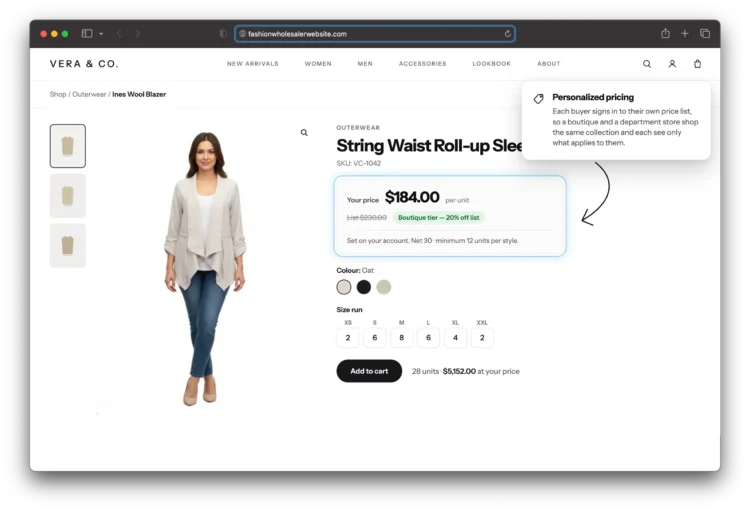
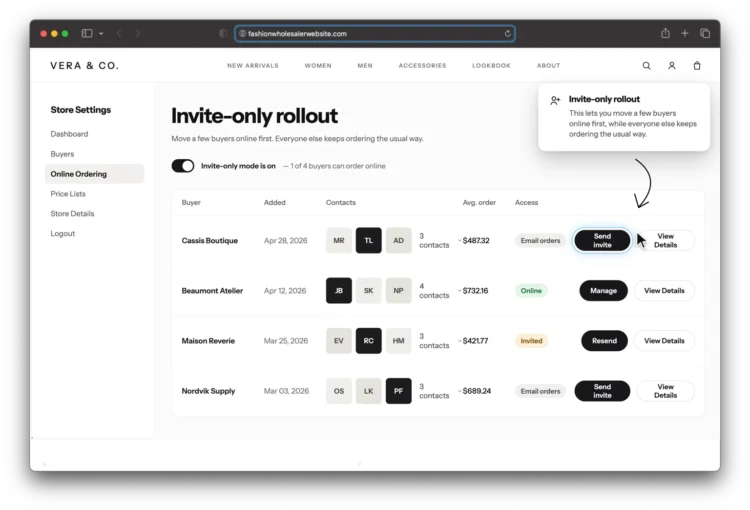
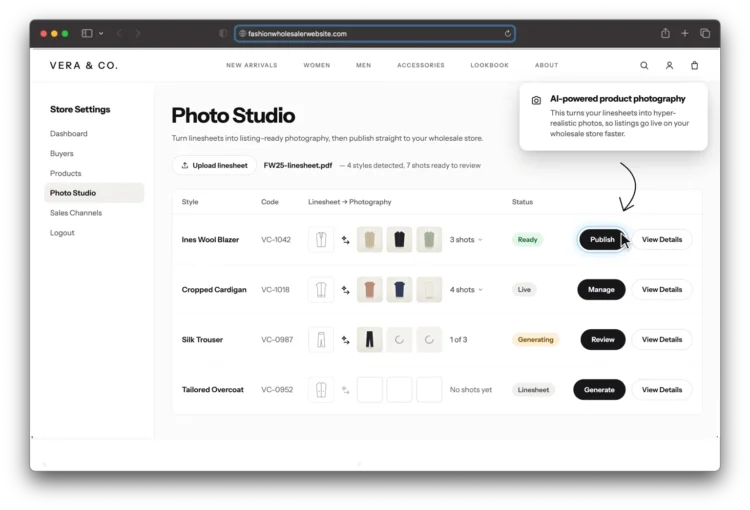
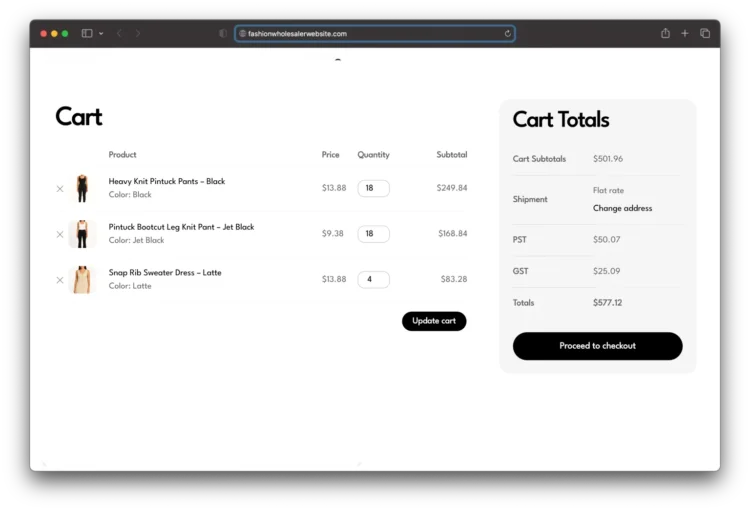
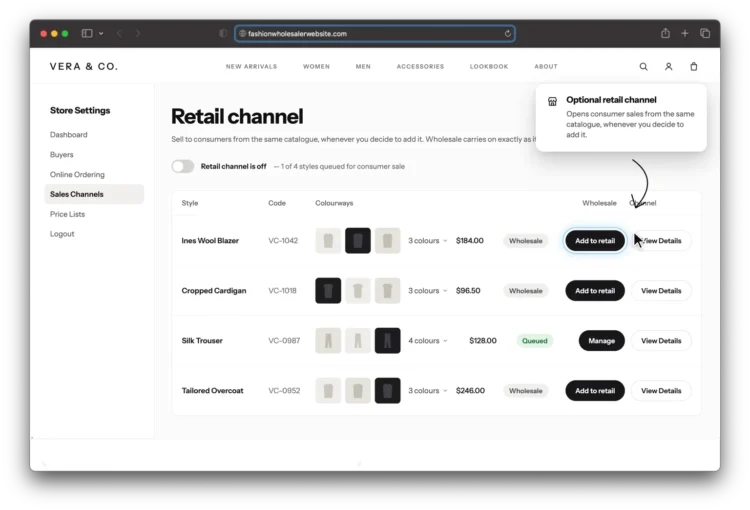
With Syndicate, you launch your own wholesale store, built from the linesheets or product PDFs you already have and the default pricing for an account. Each account logs in and sees its own prices, so the stack of PDFs with different pricing goes away. Your current buyers can keep ordering by PDF or email while you invite them over a few at a time. The store also gives your search traffic and social media somewhere to send new buyers.
Syndicate’s team provides expertise specifically for fashion and eCommerce, and we build the store for you. That takes as little as 7–10 days once we have the information we need. You own the domain, the hosting, the files and every login, and each build includes research on up to 100 wholesale buyer leads. After the first year it’s paid off, with an optional care plan for maintenance and support, from 500 CAD a month, no contract. Every lead is vetted: we confirm it’s an active business, provide contact details, and set up their account on your store with you.
What does a wholesale store cost compared with Shopify Plus?
On price, it’s $3,650 CAD a month for a store you don’t own vs from 500 CAD a month over one year for a store you do. That’s Shopify Plus on a one-year term, which is what per-account pricing costs on Shopify. Its cheaper plans run $37 to $389 CAD a month billed yearly, but they share up to three price lists across your accounts. The brands we’ve built for needed 5 to 10. If you only have one or two accounts you talk to anyway, keep selling by PDF and email and keep your money.
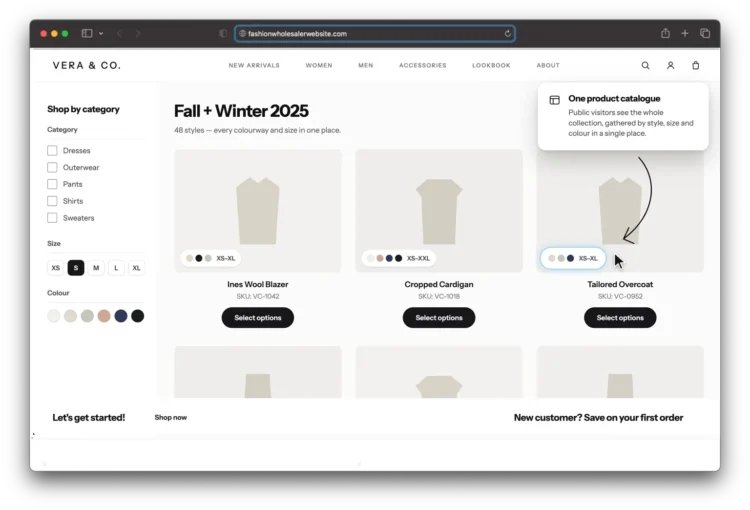
One womenswear wholesaler we work with was spending hours preparing product PDFs with different pricing for each customer. We built them a B2B eCommerce store where pricing, the catalogue, SKUs and quantities all live in one place, controlled by them. They closed a six-figure deal within 90 days of starting with us, with a buyer from the leads we researched for them. That’s one client’s result, not a promise, but it shows what the week looks like once the PDFs stop.
Where do these numbers come from?
Each figure is linked where it appears. The Fraser Institute’s per-worker figures are in inflation-adjusted 2017 dollars and leave out housing and government investment.
We checked these sources in November 2026, and the rules may change before the bill passes.
Weighing what to invest in before next season? Would it be a bad idea to see your own catalogue as a wholesale store you’d own? Book fifteen minutes or call 1-844-404-4796.