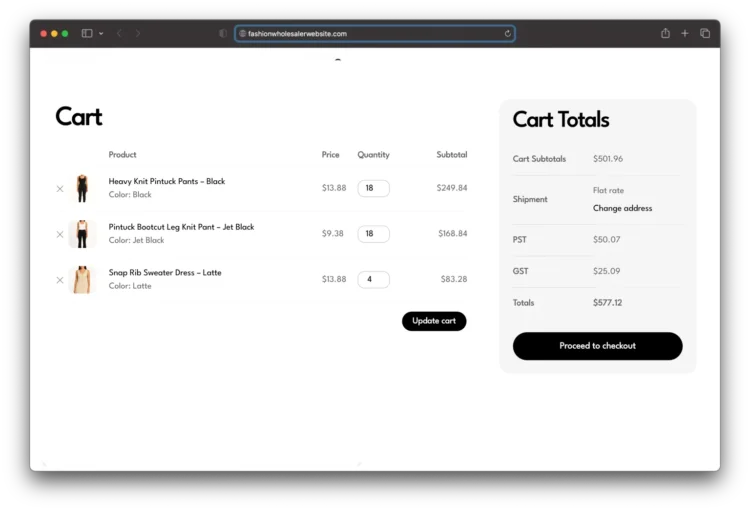
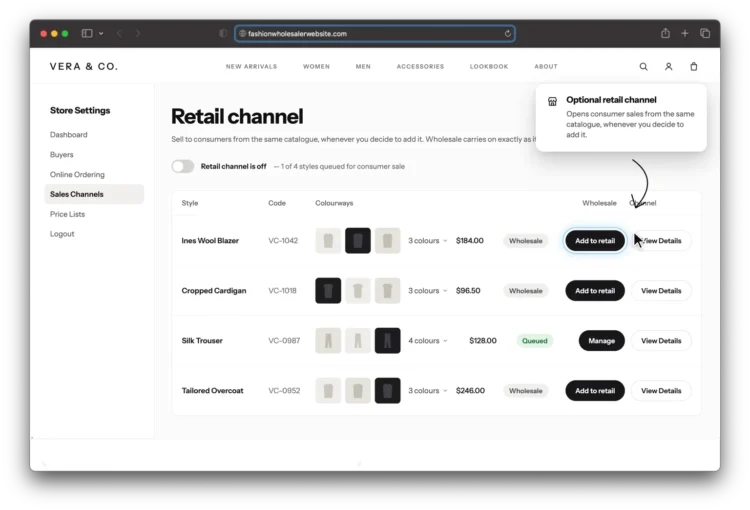
A wholesale portal is a password-protected website where your buyers log in, see your line with their own prices, and order on their own. Whether buyers use it depends less on the software than on how you launch it.
Syndicate builds wholesale fashion suppliers and distributors their own online stores, so we have a stake in what you choose.
What does wholesale ordering look like before a portal?
Every brand runs wholesale a little differently. Maybe each account gets its own PDF with its own prices. Maybe part of it lives in a tool like Brandboom or ApparelMagic. Or orders still come in by email and phone.
- Orders come back in every format. A marked-up PDF, a spreadsheet, a list typed into an email.
- Someone retypes them. Often at night, after the selling day is done.
- Reorders wait on a reply. A buyer wants more of a style that’s selling, and has to email and wait.
If that’s your week, a portal is meant to take the typing off your plate. Buyers order on their own, and the order arrives complete.
Is a wholesale portal the same as a B2B portal?
Mostly, yes. “Wholesale portal”, “B2B portal” and “B2B ordering portal” usually mean a private site where business buyers log in and order.
Watch for “B2B customer portal”. Some vendors use that name for an account page with invoices and tracking, where buyers can’t place an order. If ordering is the goal, ask to see a buyer check out.
What should a wholesale portal include?
Check for these seven features.
| Feature | What your buyers get | What you get |
|---|---|---|
| A login per account | Their own account, with their own history. | You know who’s ordering. The public sees only what you choose. |
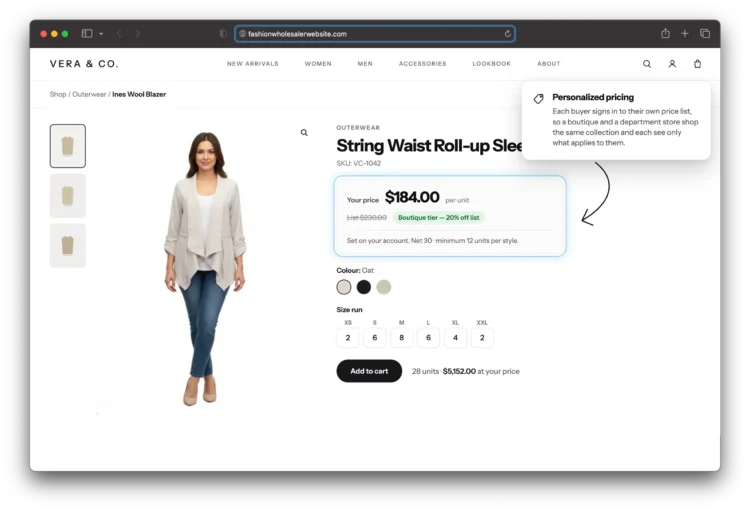
| Prices per account | Only the prices that apply to them. | No separate price files to keep straight. |
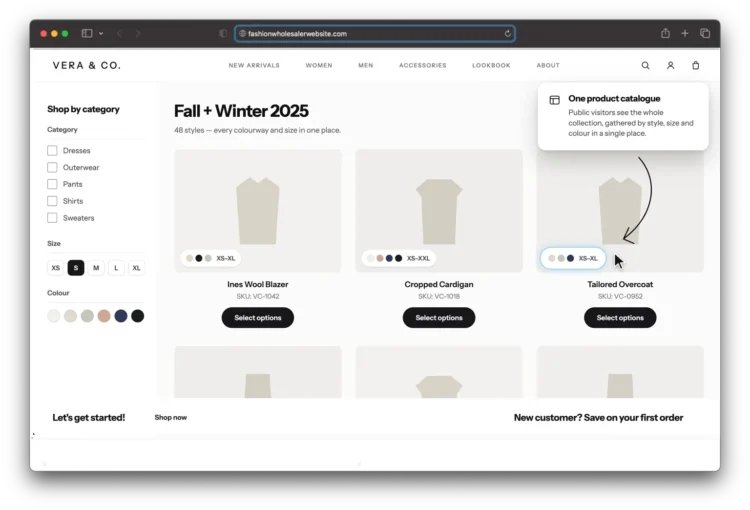
| Your current line | Styles, colours and sizes as they are this season. | No orders from last season’s PDF. |
| Cart and checkout | Sizes and quantities, sent in one go. | An order that arrives complete. |
| Reorders | A past order, placed again without an email. | Reorders that don’t wait on someone. |
| Minimums and terms | Your minimum and terms before they order. | Fewer orders sent back for being short. |
| Control over what’s public | A look at the line before they’re invited. | You choose what stays behind the login. |
On Shopify, ordering basics are no longer premium features. Shopify’s B2B documentation, checked October 8, 2026, lists easy reorders and a quick order list on every plan (Shopify B2B plan features). Prices per account are different. On Shopify, a catalog per company still needs Plus.
Why do buyers stop using a wholesale portal?
You may have tried a portal once, and nobody logged in. Reviews of wholesale platforms point to small frictions that add up.
NuORDER reviewers on Capterra describe a session that drops mid-order and makes them start again (Capterra NuORDER reviews, checked October 8, 2026). A JOOR reviewer says orders from several linesheets can’t easily go through one checkout (Capterra JOOR reviews, checked the same day).
Launch problems do the rest. Everyone gets switched over on day one, mid-season. The portal falls behind the PDF. Logging in takes longer than sending an email. Or nobody shows buyers how it works.
How do you get buyers to use a B2B ordering portal?
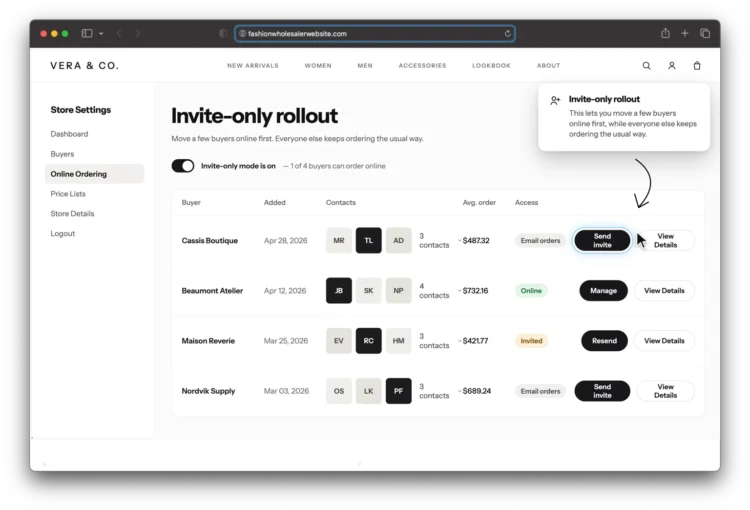
Launch it slowly, and keep the PDF going. Start with the buyers who already ask to order online. Set up their accounts with them, so the first login works and the prices are right.
Then invite buyers a few at a time, season by season. Keep the portal as current as the linesheet. When a colour drops mid-season, drop it online the same day. For the linesheet itself, see what goes on a linesheet.
What does a wholesale portal from Syndicate look like?
Syndicate’s team provides expertise specifically for fashion and eCommerce. We build a wholesale store you own, with product pages, a cart and a checkout. Prices set per wholesale customer are included.
Your current buyers can keep ordering however they’re comfortable, by PDF, email or the tool they use now. They can move to the store when they’re ready. You decide what’s public, and the rest stays behind the login.
Every build includes research on up to 100 wholesale buyer leads. Every lead is vetted: we confirm it’s an active business, provide contact details, and set up their account on your store with you.
You own the domain, the hosting, the files and every login. The store is ready in as little as 7–10 days once we have the information we need. For what a store needs, see how to take wholesale orders online without Faire or JOOR. For cost, see what each route really costs.
Is my brand too small for a wholesale portal?
Probably not, though no survey measures it directly. McKinsey’s 2024 B2B Pulse Survey studied buyers, not brands. Buyers spent about a third of their interactions on self-service at every stage of buying. McKinsey says that held whatever the buyer’s company size (McKinsey, September 2024). So self-service isn’t only for big accounts.
There are real exceptions. If you sell to one or two big accounts you talk to every week, email may be enough. The same goes if an agent takes your orders for you. In those cases, keep your money.
What does the research say about buyers ordering without a rep?
Gartner’s survey of 646 B2B buyers, run in August and September 2025, found that 67% prefer buying without a sales rep (Gartner press release, March 9, 2026). The survey covers every industry, not only fashion. The full report is for Gartner clients, so its method can’t be checked from the public release.
We checked these survey figures in October 2026. Vendors change these pages without notice, so confirm them at the linked sources before you decide.
Wondering whether your buyers would use a store you’d own? Would it be a bad idea to see what that looks like with your own products? Book fifteen minutes or call 1-844-404-4796.